Loading
reCreating Europe
  • ABOUT
    • THE PROJECT
    • THE CONSORTIUM
    • PEOPLE
    • ADVISORY BOARD
  • STAKEHOLDERS
  • ACTIVITIES & RESOURCES
  • NEWS & EVENTS
  • NEWSLETTER
  • Menu Menu
  • Mail
  • Facebook
  • Twitter
  • Youtube
  • LinkedIn

ReCreating Europe at EPIP 2021 

September 21, 2021/0 Comments/in Past Events, Activities, News, Workshops & Conferences, WP3 Authors and performers /by Rosie Allison

On 9 and 10 September 2021, several ReCreating Europe members participated in the 16th Annual Conference of the European Policy for Intellectual Property (EPIP) Association, dedicated to “IP and Future of Innovation” and hosted by the Centre of Humanities and Social Sciences of the Spanish National Research Council in Madrid.

The occasion was special, to say the least: for most of us, this was the first face-to-face conference since the outbreak of the pandemic. The prestigious venue of EPIP, which gathers more than 200 academics from across Europe every year, from different disciplines and backgrounds, made it incredibly meaningful for ReCreating Europe’s researchers to share the preliminary results of their work.

On September 9, the ReCreating Europe roundtable entitled ‘Centrifugal forces in EU copyright law’ took place. It was chaired by Martin Kretschmer, and participants included our project coordinator Caterina Sganga, WP3 members Ula Furgal and Thomas Margoni, WP3 leader Joost Poort, and WP6 leader João Pedro Quintais. Two illustrious respondents joined the roundtable, commenting on the research insights presented by the panelists: Brando Benifei, Member of the European Parliament, and Bence Kertész, from EU Commission DG CONNECT. See the full presentations on Zenodo.

The roundtable successfully managed to provide an overview of the main interim results of the project, highlighting gaps and dangers of today’s and tomorrow’s EU digital copyright scenario. ReCreating Europe’s researchers presented the innovative qualitative and quantitative research carried out in the past 20 months and the outcomes achieved by mapping and measuring the impact of the current multi-level legislative framework, with particular focus on copyright flexibilities, authors’ remuneration and bargaining power, copyright data ownership, transparency and AI technologies, and intermediaries and content moderation.

On September 10, another ReCreating Europe panel took place. This time the session was dedicated to the presentation of the results of the work conducted within WP2 on End-Users and Access to Culture. The panel featured three paper presentations: First, Giulia Rossello and Arianna Martinelli presented their ongoing empirical work under the title “Sci-Hub and Academics: Survey evidence from EU countries”, illustrating the survey they circulated across six European countries on academics’ perception of copyright law and the diffusion of academic digital piracy; Then, Giulia Priora and Caterina Sganga presented their upcoming paper “Betwitxt EU and national: the present and future of copyright flexibilities”, based on their legal mapping across all 27 Member States and related thorough comparative analysis of the legal understandings underlying EU copyright flexibilities; And finally, Peter Mezei and Istvan Harkai presented their published contribution entitled “End-user flexibilities in digital copyright law – An empirical analysis of end-user license agreements”, in which they explore the private ordering facet of copyright regulation and the way platforms’ end-users license agreements interact end-users’ freedoms and experiences. To see all the presentations from this session, they are available on Zenodo.

The EPIP conference turned out to be an incredibly fruitful moment of exchange and discussion of ReCreating Europe’s numerous preliminary results, and an important moment of assessment of the work done so far and our future plans. The cross-disciplinary research efforts and enthusiastic activities carried out since January 2020 from ReCreating Europe’s researchers met the genuine interest of academics, policymakers, and stakeholders in the audience – making the three-day-long conference not only an important moment of discussion but also an input for ReCreating Europe’s team for further work and collaborations within the scope of the project’s activities and objectives.

Stay tuned as further events will soon follow!

https://recreating.eu/wp-content/uploads/2021/09/1.jpg 540 644 Rosie Allison https://recreating.eu/wp-content/uploads/2020/11/recreatingEurope-logo.png Rosie Allison2021-09-21 08:56:222021-09-21 08:56:22ReCreating Europe at EPIP 2021 

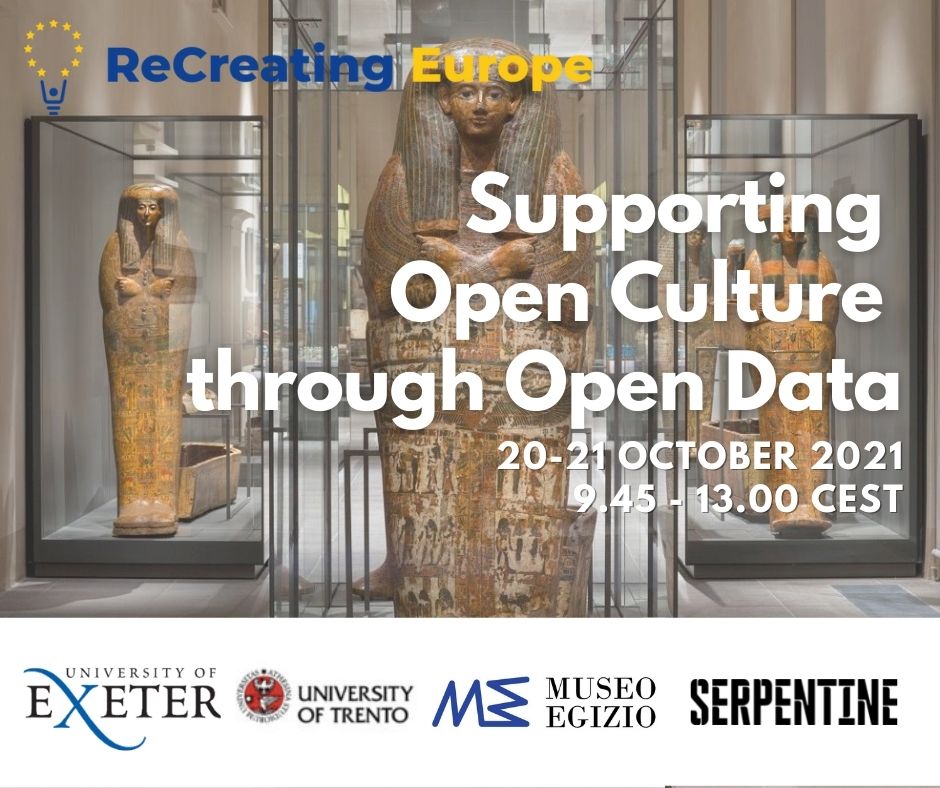
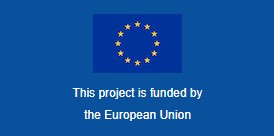
Workshop (October 20-21): Supporting Open Culture through Open Data

August 17, 2021/0 Comments/in Galleries, Libraries, Museums & Archives, Activities, News, Stakeholders /by Rosie Allison

Join our upcoming workshop on legal aspects related to digitisation for Galleries and Museums (GM) on October 20-21, hosted by Museo Egizio (Egyptian Museum) in Turin, Italy.

Co-organisers: reCreating Europe, GLAM-E Lab, Egyptian Museum, Serpentine Legal Lab

Other contributors: Creative Commons + Creative Commons – Italian Chapter, Wikimedia Foundation + Wikimedia Italia, Europeana, Fondazione Torino Musei, inDICEs Project, ICOM Italia
Description

The European Strategy for Data, ideally aimed at shaping Europe’s digital future through the creation of a single market for data, has a very ambitious agenda. It promises to increase the volume and the value of data as well as the number of citizens, professionals and businesses dealing with data. It also promises clear and fair rules on access and re-use of data.

However, such a promising programme faces legal challenges that pose real barriers to the achievement of these goals, especially in the context of cultural heritage, where the principle of open by design and open by default appears undermined and less inclined to flourish. Cultural Heritage institutions are in fact still struggling to overcome the legal barriers to access cultural data, and even more so in their capacity to reuse such data.

The implementation of the EU Directive on Open Data and reuse of PSI (2019/1024), despite including important exceptions for CHIs, might facilitate the re-use of data for the purpose of creating new (digital) works (especially when the institution is a co-creator) and generate new knowledge. This, however, depends on its knowledgeable transposition in the national laws of Member States and its appropriate link with the EU Directive on Copyright in the Digital Single Market (2019/790). Pending its national implementation, the pro-open practices and the institutional policies followed by CHIs indeed prove that steps, however small, are being taken towards it.

After attending this workshop, participants will:

  • be able to understand restrictions and hidden opportunities of copyright law and the key roles of open data policies in the creation and re-use of cultural contents;
  • contribute to the mapping of stakeholder practices related to copyright and open data policies;
  • contribute ideas to the drafting of broader institutional policies.

Target audience:

DAY 1 and 2 – Galleries and Museums (members of staff)

DAY 2 – Researchers, educators and students, policymakers, general public

How to participate

The workshop will take place online but will be hosted by Museo Egizio in Turin, Italy. Attendance of the DAY I is limited, so please, register HERE early. To participate in DAY 2, please, register HERE.

Non-mandatory reading material will be provided to participants prior to the workshop. Short reading materials will instead be provided for those interested in participating in the breakout sessions.

Please note, that automatic Zoom closed-captioning will be enabled throughout the event to facilitate the attendance of persons with hearing impairment.

During the second day of the workshop sign-language interpretation (LIS) will be provided in the morning and simultaneous (Italian to English) interpretation limited to the roundtable of local Italian experts (approximately 1 hour).

SCHEDULE

DAY 1 (9.45-13.00)

  • Welcome and introduction – Giulia Dore, reCreating Europe
  • Opening Keynote 1 – Fiona Romeo, WMF
  • Opening Keynote 2 – Fabio Viola, Tuo Museo
  • Breakout sessions 1-6 (see descriptions below)
  • Coffee Break
  • Virtual tour of Museo Egizio (approximately 40 minutes)
  • Plenary discussion

DAY 2 (9.45-13.00)

  • Welcome and introduction – Roberto Caso, reCreating Europe
  • Roundtable – Open Data | Open Culture: Highlights from Five Projects
    Chair: Brigitte Vezina, Creative Commons
    Speakers:

    • Caterina Sganga, reCreating Europe
    • Alana Kushnir, Serpentine Legal Lab
    • Andrea Wallace, GLAM-E Lab
    • Francisco Duque Lima, INDICes
    • Ariadna Matas, Europeana
  • Coffee Break
  • Closing roundtable – Challenges in supporting Open Culture: the case of Italy (in Italian with simultaneous interpretation in English):
    Chair: Roberto Caso
    Speakers:

    • Christian Greco, Museo Egizio
    • Deborah de Angelis, ICOM Italia DCHRG and CC IT Chapter
    • Mirco Modolo, CC IT Chapter
    • Iolanda Pensa, WM Italia
    • Elisabetta Rattalino & Dr. Anna Follo, Fondazione Torino Musei
  • Closing Keynote – Emily Hudson
  • Wrap-up and closing

_______

PARALLEL BREAKOUT SESSIONS (DAY 1):

  1. Co-creation in contemporary art and design

This breakout session will explore the topics surrounding re-use of open cultural data to create new artistic works and works of industrial design.

Participants will discuss the applicable legal framework, particularly in terms of copyright law – exploring issues related to copyright subsistence, authorship and joint-authorship, ownership – and its interface with other areas of the law. Participants will also take a look at the opportunities presented by open policies at the international and EU level and see how these may be implemented within the given legal context.

Presenters: Estelle Derclaye, University of Nottingham; Marta Iljadica, reCreating Europe.

  1. Public domain and institutional open policies

This breakout session will focus on the interrelation between cultural institutions and works belonging to the public domain. Developing and testing creative ways of promoting access to culture, CHIs carry out ever newer uses of such contents, from 2D- and 3D-reproductions of artworks to VR experiences. The very nature of the public domain casts away the possibility of restrictions being imposed by copyright law. However,  doubts may arise with regards to innovative uses and re-uses of such works as well as strategies to keep content and data openly available while amortizing the incurred costs. Participants will be invited to reflect and discuss upon the notion of public domain, its underlying goals and meaning within the evolving practices of galleries and museums, sharing their views and experiences on, among others, Article 14 of the new Copyright Directive.

Presenters: Emily Hudson, King’s College; Giulia Priora, reCreating Europe.

  1. Intangible cultural heritage, traditional knowledge and cultural expressions, and digital heritage management

This breakout session will examine the roles of intellectual property and open access relating to the stewardship of traditional cultural expressions and Indigenous cultural property. Digitisation produces a reproduction that can be studied, made available online or even repatriated to the community of origin. Yet it also creates a new digital asset that revives old questions around authenticity, ownership, and control over the underlying traditional knowledge and cultural expressions and intangible cultural heritage. Participants will be introduced to the various topics and processes that should inform the management and digitisation of these materials, including the ethical and equitable dimensions to copyright, Creative Commons licenses and other labels, and open access policies.

Presenters: Brigitte Vezina, Creative Commons; Andrea Wallace, GLAM e-Lab.

  1. Technology, born-digital art and preservation

This breakout session is dedicated to the overlaps of the non-fungible tokens (NFT) craze of 2021, copyright law and cultural preservation. NFTs allow the tokenization of culturally relevant expressions, and share them with others, including collectors, via digital marketplaces. This way they contribute to the circulation of born-digital art and open up new channels of preservation of cultural expressions. The goal of the panel is to present those challenges of the recent developments in this field that might be relevant for the GLAM sector.

Presenters: Péter Mezei, University of Szeged; Ioanna Lapatoura, University of Nottingham.

  1. Educating the voices of the next generation: IP, value and creative agency

This breakout session will explore the relational role IP can play for creatives when working in interdisciplinary and international ways. For those starting a business, freelancing or being employed, understanding and negotiating the importance of IP is often learnt by doing. In creative education, it’s evident that many ideas extend beyond traditional business models where financial gain is a primary driver, with a focus on social, cultural and environmentally-conscious initiatives. IP can represent a creative’s agency for positive change, a way to identify their future selves and consider the ethical dimensions of their work to encourage healthy collaborations.

For those who represent the next generation of changemakers, innovators and thought leaders, this session will encourage participants to consider the centrality of IP beyond legal frameworks to a practice-led approach considering a creative’s vision, their identity and future impact on society.

Presenters: Roxanne Peters, Creative and Cultural IP Rights Specialist at UAL; Alana Kushnir, Serpentine Legal Lab

  1. Data, ethics and privacy

This breakout session is dedicated to exploring the interplay of copyright, data protection and ethics in the activities of cultural heritage organizations. Digitization of collections and creation of activities and contents tailored to the online environment suggest adopting a comprehensive approach to tackle this complex interaction.

Where several issues arise in the compliance with data protection laws, considerations about ethics seem also to take a crucial role in the digital environment, e.g. considering copyright exceptions and limitations or moral rights.

Participants are invited to discuss the current scenario addressing the opportunities and obstacles under the applicable legal framework and exchange ideas on the potential future developments of the subject matter.

Presenters: Naomi Korn, University of Edinburgh; Marta Arisi, reCreating Europe

____

This project has recieved funding from the European Union’s Horizon 2020 research and innovation programme under grant agreement No. 870626.

https://recreating.eu/wp-content/uploads/2021/08/FINAL_logo-1.jpg 788 940 Rosie Allison https://recreating.eu/wp-content/uploads/2020/11/recreatingEurope-logo.png Rosie Allison2021-08-17 14:07:062021-10-07 07:24:15Workshop (October 20-21): Supporting Open Culture through Open Data

Web conference on CDSM Directive

June 3, 2021/0 Comments/in Activities, Creative industries, End users, Galleries, Libraries, Museums & Archives, Intermediaries, News, Stakeholders /by Rosie Allison

“The implementation of the CDSM Directive: snapshots into the future of EU copyright law”

21 June 2021, 2:00 – 6:00 PM (CEST)


To register: CLICK HERE


In the context of our cross-disciplinary and transnational research activities, we are glad to invite you to our next web conference on the process of implementation of the CDSM Directive.

The conference will feature two keynote speakers, Professor Raquel Xalabarder (Universitat Oberta de Catalunya) and the First Advocate General Maciej Szpunar (Court of Justice of the EU), two presentations of CDSMD implementation trackers, and four thematic panels. Each panel will be devoted to a topic that is touched by the Directive and has been subject to ReCreating Europe’s research (exceptions and limitations, authors’ remunerations and reversion right, automated content-filtering, preservation of cultural heritage). The presentation of our interim results will be commented upon by respondents representing stakeholders, policymakers, legal experts and the civil society. We look forward to your participation in the discussion!


PROGRAM

2:00-2:05 pm – Greetings, introduction of reCreating Europe (Caterina Sganga, Scuola Superiore Sant’Anna – Coordinator, reCreating Europe)

Keynotes

2:05-2:20pm – The aftermath of CDMSD: where do we stand, where shall we go? (Raquel Xalabarder, Professor of Intellectual Property, Universitat Oberta de Catalunya)

2:20-2:35pm – The future of EU copyright harmonization: which role for the CJEU? (Maciej Szpunar, First Advocate General of the Court of Justice of the European Union)

2:35-2:45 Q&A

Intermezzo: implementation trackers

2:45-2:55pm – CDSMD implementation tracker (Martin Kretschmer, Professor and Director, CREATe – University of Glasgow)

2:55-3:05pm – The new copyrightexceptions.eu (Paul Keller, President, Communia)

Panel sessions

3:05-3:45pm – Panel 1: Remuneration and reversion rights

  • Chair: Rebecca Giblin (Associate Professor, University of Melbourne; Director, IP Research Institute of Australia (IPRIA))
  • Presenters: Ula Furgal (Research Fellow, CREATe – University of Glasgow), Joost Poort (Associate Professor and Vice-Director, IViR – University of Amsterdam)
  • Respondents: Eanna Casey (Chairman of the Board, Societies’ Council for the Collective Management of Performers’ Rights (SCARP)); Cecile Deniard (Vice-President, European Council of Literary Translators’ Associations (CEATL))

3:45-4:00pm Virtual coffee break (in breakout rooms)

4:00-4:40pm – Panel 2: A new era for copyright exceptions and limitations?

  • Chair: Christophe Geiger (Professor of Law, CEIPI – University of Strasbourg)
  • Presenters: Caterina Sganga (Associate Professor of Private Comparative Law, Scuola Superiore Sant’Anna), Thomas Margoni (Research Professor, KU Leuven; Fellow, CREATe)
  • Discussants: Agustin Reyna (Director, Legal and Economic Affairs, BEUC), Jeremy Rollinson (Senior Director of European Government Affairs, Microsoft)

4:40-5:20pm – Panel 3: Setting the rules for automated content-filtering

  • Chair: Eleonora Rosati (Professor of Intellectual Property Law, University of Stockholm)
  • Presenters: João Pedro Quintais (Assistant Professor, IViR – University of Amsterdam), Sebastian Schwemer (Associate Professor, CIIR – University of Copenhagen)
  • Discussants: Cédric Manara (Head of Copyright, Google), Martin Husovec (Assistant Professor, LSE)

5:20-6:00pm – Panel 4: Preservation of cultural heritage

  • Chair: Andrea Wallace (Senior Lecturer in Law, University of Exeter)
  • Presenters: Giulia Dore (Research Fellow, University of Trento), Marta Iljadica (Lecturer in Law, CREATe – University of Glasgow)
  • Discussants: Ariadna Matas (Policy Advisor, Europeana); Ben White (Chair of Copyright Working Group, LIBER)


https://recreating.eu/wp-content/uploads/2021/06/Copyright-law.jpg 620 935 Rosie Allison https://recreating.eu/wp-content/uploads/2020/11/recreatingEurope-logo.png Rosie Allison2021-06-03 16:03:392021-06-15 16:24:00Web conference on CDSM Directive
Page 2 of 212

Pages

  • Activities & Resources
  • ADVISORY BOARD
  • Back online soon…
  • Contact us
  • Cookie Policy
  • Databases and datasets
  • Final Conference Programme
  • forumup
  • Groups
  • Home
  • News & Events
  • Newsletter ReCreating Europe
  • PEOPLE
  • Policy papers
  • Policy recommendations, guidelines, best practices
  • Privacy Policy
  • Reports and studies
  • Stakeholders
  • The Consortium
  • THE PROJECT

Categories

  • Activities
  • Creative industries
  • End users
  • Galleries, Libraries, Museums & Archives
  • Intermediaries
  • Mapping, Measuring, Studying
  • News
  • Past Events
  • Stakeholders
  • Workshops & Conferences
  • WP2
  • WP3 Authors and performers
  • WP5
  • WP6
  • WP7

Archive

  • March 2023
  • January 2023
  • December 2022
  • November 2022
  • October 2022
  • August 2022
  • June 2022
  • April 2022
  • January 2022
  • December 2021
  • November 2021
  • October 2021
  • September 2021
  • August 2021
  • July 2021
  • June 2021
  • April 2021
  • March 2021
  • December 2020
  • September 2020
  • July 2020
  • May 2020

CC BY reCreating Europe
Privacy Policy | Cookie Policy

Sitemap

  • THE PROJECT
  • THE CONSORTIUM
  • PEOPLE
  • STAKEHOLDERS
  • ACTIVITIES & RESOURCES
  • NEWS
  • NEWSLETTER
  • CONTACT US

The Coordinator

Scuola Superiore Sant’Anna
Piazza Martiri della Libertà, 33
56127 Pisa
Italy

Social

This project is funded by
the European Union

This project has received funding from the European Union’s Horizon 2020 research and innovation programme under grant agreement No 870626

Scroll to top